
Introduction
Hello, wonderful baker! Are you ready to dive into a delightful culinary adventure that will not only impress but also bring you immense joy? Today, we’re going to unlock the secrets to making gourmet chocolate covered orange peel right in your own kitchen! You might think it sounds fancy, but trust me, it’s surprisingly easy, incredibly rewarding, and an absolute joy to create something so beautiful and delicious from scratch. This comprehensive guide is designed to be your trusted companion, walking you through every single step needed to craft perfect, shiny, and utterly irresistible chocolate covered orange peel.
Why You’ll Adore Making These Chocolate Covered Orange Peels
Get ready to fall in love with this recipe! Here’s why these homemade chocolate covered orange peels are about to become your new favorite:
- Impressive Yet Simple: They look incredibly sophisticated, making them perfect for special occasions, but the process is straightforward and foolproof.
- Perfect for Gifting: Handcrafted treats like these make thoughtful, unique gifts that everyone will cherish.
- Uses Up Leftover Oranges: A brilliant way to utilize those extra oranges, transforming them into a high-quality gourmet delight.
- Gourmet Treat Without the Gourmet Price Tag: Enjoy a luxurious confection without the premium cost of store-bought versions.
Choosing the Best Oranges for Your Chocolate Covered Orange Peel
The secret to exceptional chocolate covered orange peel begins with selecting the right oranges. For the best flavor and texture, look for varieties like Navel or Valencia oranges. These tend to have thicker peels which are ideal for candying. Always prioritize organic oranges, especially since you’ll be consuming the peel. This ensures they are free from pesticides and waxes. When choosing, pick oranges that feel heavy for their size, have vibrant, unblemished skin, and a firm texture. Avoid any that feel soft or have visible mold or bruises.
Essential Tools for Homemade Chocolate Covered Orange Peel
Gathering your tools before you start will make the process smooth and enjoyable. Here’s what you’ll need:
- A sharp knife and a sturdy cutting board for preparing the peels.
- A medium saucepan for boiling and candying the peels.
- A colander for draining the peels.
- Tongs for handling the hot peels.
- A drying rack set over parchment paper for the crucial drying stage.
- A double boiler or a microwave-safe bowl for melting chocolate.
Ingredients for Your Easy Chocolate Covered Orange Peel
- 3 oranges (recommend organic as you’re eating the peel)
- 2 cups water
- 1 cup sugar (plus more for coating)
- 1 vanilla bean (optional)
- chocolate (optional)
Step-by-Step Instructions: How to Make Chocolate Covered Orange Peel
- Preparing Your Oranges: Gently wash the outside of the oranges under the faucet with a vegetable brush. Use a knife to slice off a very small amount on the top and bottom of the orange, then score the orange through the peel to the pith (without cutting through the orange), making 4 cuts lengthwise. Carefully remove each section of orange peel, then slice into 1/4-inch wide strips.
- Boiling to Banish Bitterness: Add the orange peel strips to a pot and cover with about an inch of water. Bring this to a boil, then drain over a colander and repeat once more.
- Candying the Peels to Perfection: Add the orange peel strips back to the pot along with 2 cups of water, 1 cup of sugar and the vanilla bean. Bring to a boil, then reduce the heat to a simmer. Simmer uncovered for about 30-35 minutes. The orange peels should be slightly translucent and most of the simple syrup will have evaporated. Turn off the heat and let the orange peel cool in the remaining sugar for 5 minutes.
- The Crucial Drying Process: Use tongs to remove the orange peel to a drying rack set over parchment paper. Let the orange peel dry for at least 8 hours, though preferably 24 hours.
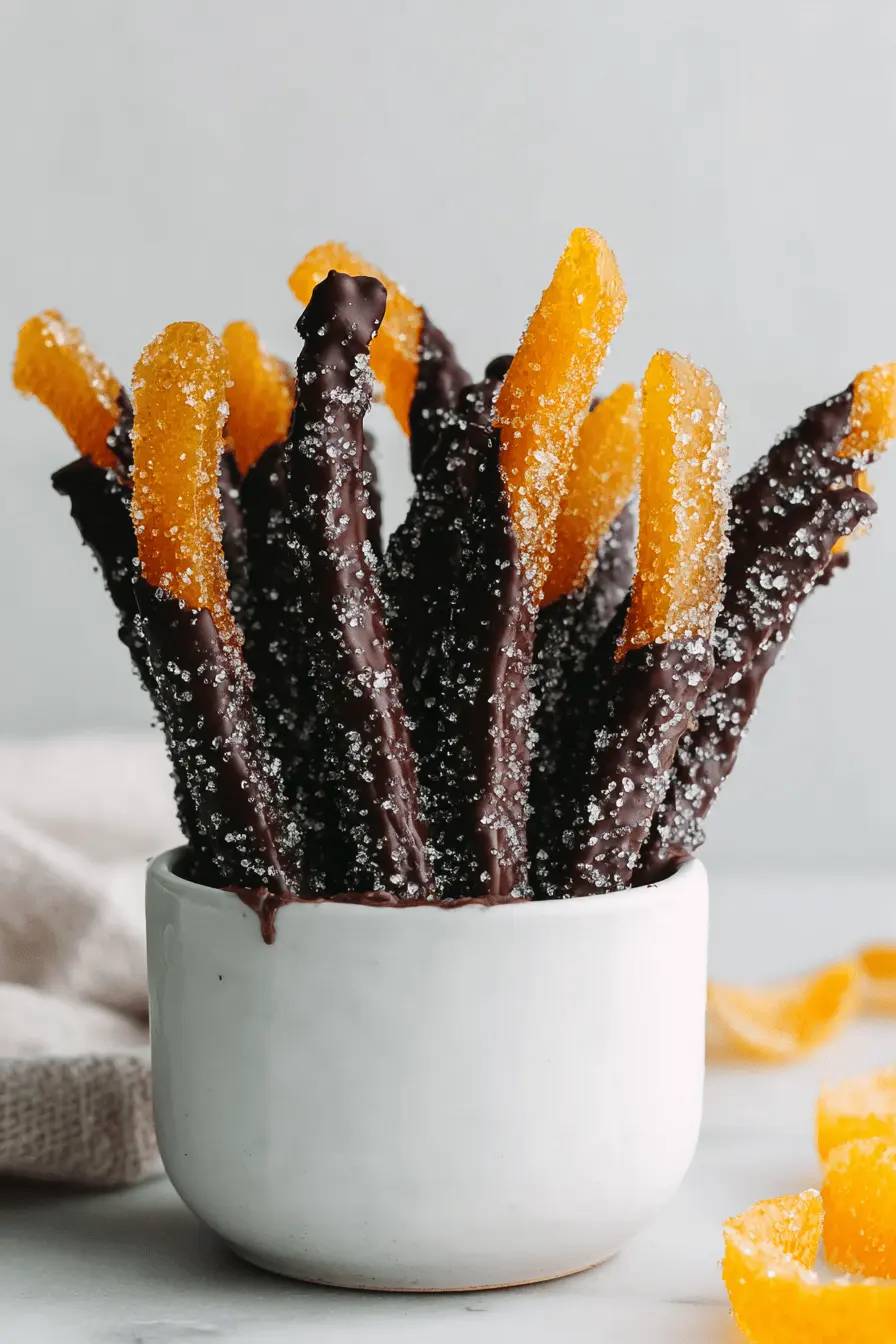
- Dipping in Chocolate & Finishing Touches: Coat the orange peel in additional granulated sugar and if you’d like, dip them in chocolate and cool. Enjoy immediately or store in an airtight container in the fridge.
Tips for Foolproof Chocolate Covered Orange Peel Every Time
You’ve got this! Here’s some expert advice to ensure your chocolate covered orange peels turn out perfect, every single time.
Troubleshooting Common Issues
Encountering a hiccup? Don’t worry, here are solutions to common problems:
- Why are my peels too soft? This often means they weren’t candied long enough or dried sufficiently. Ensure they simmer until translucent and allow ample drying time.
- Why are my peels too hard? They might have been over-candied or dried in an environment that was too hot or dry, causing them to become brittle.
- Why are my peels bitter? Inadequate boiling steps are usually the culprit. Make sure to perform the double boil to remove bitterness effectively, and try to remove as much white pith as possible from the peels before candying.
Expert Chocolate Tempering for a Professional Finish
Achieving a glossy, snap-worthy chocolate coating comes down to tempering. Tempering stabilizes the chocolate’s cocoa butter crystals, preventing bloom (white streaks) and ensuring a beautiful finish. You can use a double boiler method or a microwave seeding method. For the double boiler, gently melt 2/3 of your chocolate over simmering water (not boiling!) until it reaches 115-120°F (46-49°C) for dark chocolate, or 105-110°F (40-43°C) for milk/white chocolate. Remove from heat, add the remaining 1/3 of chocolate (finely chopped), and stir until it melts and cools to 88-91°F (31-33°C) for dark, or 84-86°F (29-30°C) for milk/white. The chocolate should be smooth and flow easily. If it becomes too thick, you can gently warm it briefly over the double boiler again.
Creative Ways to Enjoy and Gift Your Chocolate Covered Orange Peel
Your homemade treats are not just for eating—they’re for sharing and celebrating! Get creative with how you enjoy and present them.
Gifting Ideas & Packaging Inspiration
Homemade chocolate covered orange peels make exquisite gifts. Here are some ideas to make them look professional:
- Place them in small, elegant decorative boxes lined with tissue paper.
- Package them in clear cello bags tied with festive ribbons.
- Create a gourmet gift basket with your orange peels, a selection of teas or coffees, and perhaps some other homemade confections.
- Consider adding a personalized tag with a handwritten message.
Perfect Pairings
These delightful treats pair beautifully with a variety of beverages and foods:
- Enjoy them with a warm cup of coffee or a robust black tea.
- Serve them alongside a digestif or a sweet dessert wine.
- They make an excellent addition to a sophisticated cheese board.
- Crumble them over vanilla ice cream for an elevated dessert.
Storing Your Homemade Chocolate Covered Orange Peel
To keep your delicious chocolate covered orange peels fresh and flavorful, proper storage is key.
- Candied (un-dipped) Peels: Store in an airtight container at room temperature for up to 2 weeks, or in the refrigerator for up to 1 month.
- Chocolate-Dipped Peels: Store in an airtight container in the refrigerator for up to 2-3 weeks. The chocolate will help preserve them. If tempered correctly, they can sometimes be kept at cool room temperature for a week, but refrigeration is safer for extended storage.
- Freezing: Both candied and chocolate-dipped peels can be frozen for up to 3 months. Place them in a single layer on a baking sheet to freeze solid, then transfer to a freezer-safe bag or container, separating layers with parchment paper. Thaw in the refrigerator before serving.
Frequently Asked Questions About Chocolate Covered Orange Peel
Here are answers to some common questions you might have about making these delectable treats.
Can I use other citrus fruits for candied peels?
Absolutely! Many other citrus fruits can be candied, each offering a unique flavor profile. Here are a few options:
| Citrus Type | Flavor Profile | Notes on Preparation |
|---|---|---|
| Lemon | Tangy, Bright | May require extra boiling to reduce bitterness. |
| Grapefruit | Bitter-sweet | Thicker peel, can be quite bitter; ensure thorough boiling. |
| Lime | Zesty, Aromatic | Smaller peels, great for delicate garnishes. |
What kind of chocolate is best for dipping?
The best chocolate depends on your preference! Dark chocolate (60-75% cocoa solids) is a classic choice, offering a beautiful contrast to the sweet-tart orange. Milk chocolate provides a sweeter, creamier coating, while white chocolate can add a different aesthetic and flavor. For best results, use high-quality couverture chocolate, as it melts and tempers more smoothly. Brands like Ghirardelli, Callebaut, or Valrhona are excellent choices.
Why are my orange peels bitter?
Bitterness usually stems from insufficient removal of the white pith (the spongy layer between the peel and the fruit) or not boiling the peels enough. Ensure you carefully scrape off as much pith as possible from the inner side of the peel, and strictly follow the instruction to boil and drain the peels twice before candying. This process leaches out most of the bitter compounds.
How can I speed up the drying process?
While natural air drying for 8-24 hours is ideal, you can speed it up with caution. A very low oven (around 150-200°F / 65-93°C) with the door slightly ajar can dry them in 1-2 hours. Keep a close eye on them to prevent burning. A food dehydrator on a low setting can also work. Be careful not to over-dry, as they can become brittle.
Can I use sugar substitutes?
Yes, you can experiment with sugar substitutes, but be aware that the texture and shelf life may differ. Honey or maple syrup can be used, but they will impart their own flavor and may make the peels stickier. For sugar-free options, erythritol or xylitol can work in similar ratios to sugar, but they might not create the same translucent, glossy finish and may crystallize differently. Always taste and adjust as you go.
How do I know if my chocolate is tempered correctly?
You’ll know your chocolate is properly tempered if it has a beautiful shine, a satisfying “snap” when broken, and sets quickly at room temperature without any streaks or dull patches (known as “bloom”). A simple test is to dip a spoon or the tip of a knife into the chocolate; it should set within 3-5 minutes with a smooth, glossy finish. For more detailed guidance, refer back to the “Expert Chocolate Tempering” section.
Conclusion
There you have it! You’ve just mastered the art of making exquisite chocolate covered orange peel – a truly gourmet treat, made with your own hands. Isn’t it wonderful how something so elegant can be so easy and rewarding to create? We hope this guide has filled you with confidence and inspired you to embrace the joy of homemade confections. Now it’s your turn! We’d absolutely love to hear about your experience. Leave a comment below with your favorite citrus variation, ask any questions if you encountered a tricky spot, or better yet, share your beautiful chocolate covered orange peel creations on social media using #AishaRecipes! Happy candying!
Chocolate Covered Orange Peel
Ingredients
Equipment
Method
- Wash oranges thoroughly with a vegetable brush.
- Trim the ends of the oranges, then score the peel into four lengthwise sections, cutting to the pith.
- Remove the peel sections and slice them into 1/4-inch wide strips.
- Place strips in a pot, cover with water, bring to a boil, drain, and repeat the process once.
- Return peels to the pot with fresh water, sugar, and vanilla bean; boil, then simmer uncovered for 30-35 minutes until translucent and syrup evaporates. Let cool for 5 minutes in the remaining syrup.
- Transfer the peels to a drying rack over parchment paper and allow them to dry for 8-24 hours.
- Coat the dried orange peel in extra granulated sugar, and optionally dip in melted chocolate before cooling.
- Serve immediately or store in an airtight container in the refrigerator.