
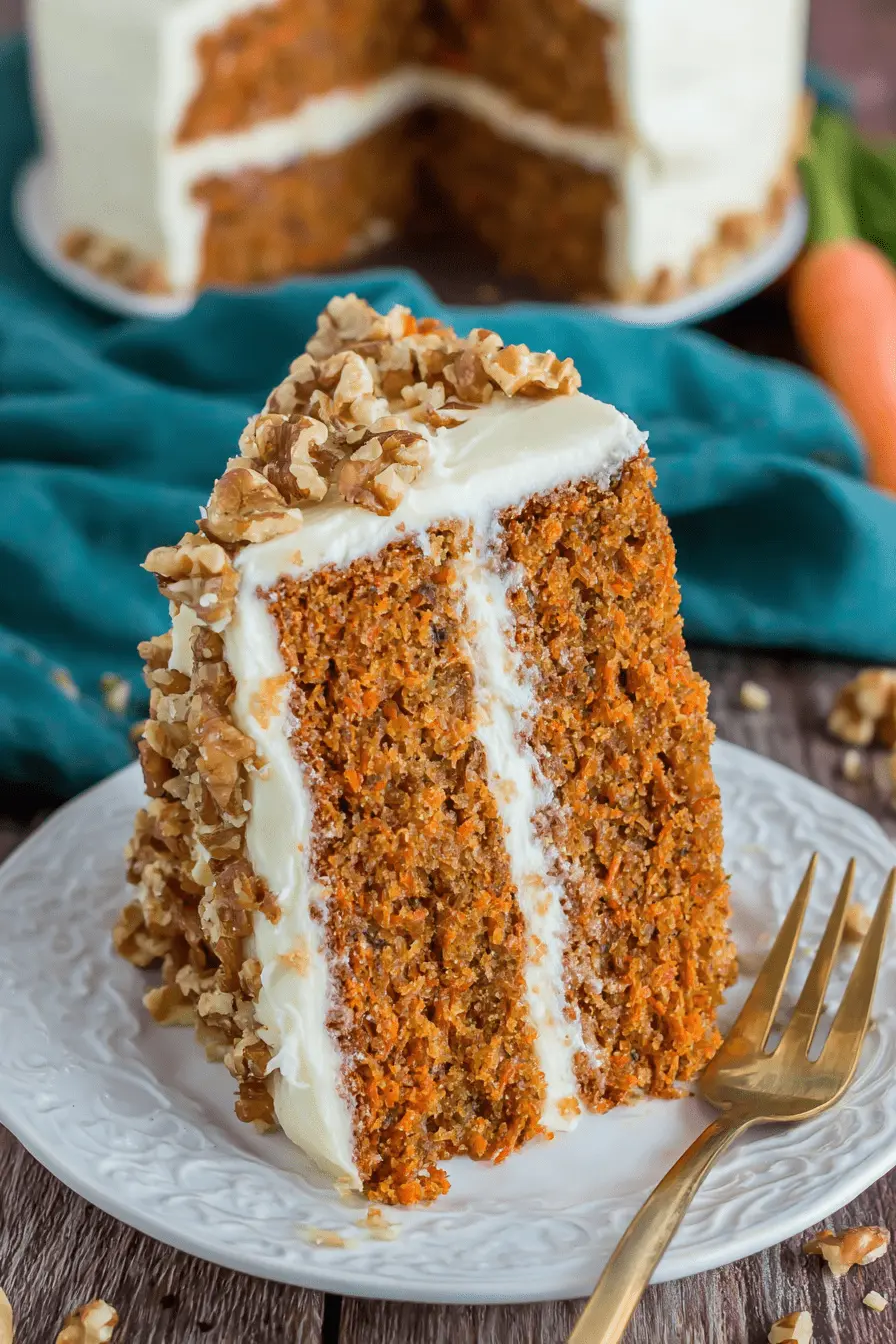
I still remember my first attempt at carrot cake. The kitchen was a mess of grated carrots and spilled flour, but that first bite? Pure magic. After years of tweaking, I’ve perfected this recipe that brings together warm spices, incredible moisture, and that classic cream cheese frosting we all crave. It’s my go-to celebration cake that takes about an hour of active time, plus cooling – but trust me, it’s worth every minute.
Why This is the BEST Carrot Cake Recipe You’ll Ever Make
- Unparalleled moisture thanks to my secret ingredient – applesauce! It works alongside the oil to create a cake that stays tender for days without drying out.
- Perfectly balanced spices that offer warmth without overpowering the natural sweetness of the carrots. The combination of cinnamon, ginger, and nutmeg creates that classic carrot cake flavor you’re looking for.
- The dreamiest cream cheese frosting that strikes the perfect balance between sweet and tangy, complementing the cake without making it overly sweet.
- Foolproof instructions that guide you through each step, ensuring baking success even if you’re new to layer cakes. Just like our foolproof creamy strawberry cheesecake bars, I’ve tested this recipe dozens of times to make it truly fail-proof!
A Sweet History: The Story Behind Your Favorite Carrot Cake
Carrot cake’s history dates back centuries, with roots in medieval European cooking when sugar was expensive and carrots provided natural sweetness. The modern version we love today gained popularity in the United States during the 1960s and 70s, when it became synonymous with health-conscious baking (though I think we can all agree that the cream cheese frosting negates some of those health claims!).
What began as a practical way to use abundant vegetables transformed into one of the world’s most beloved desserts. For other beloved sweet treats, explore our sensational homemade chocolate pudding. And while there are countless variations, this classic recipe captures the essence of what makes carrot cake so irresistible.
Essential Baking Tools for Your Carrot Cake Journey
Before diving into the recipe, let’s make sure you have the right equipment for success:
- Two 9-inch round cake pans – Essential for creating those perfect layers. Look for ones with straight sides for professional-looking results.
- Box grater or food processor – For transforming whole carrots into the fine shreds that give this cake its distinctive texture and moisture.
- Stand mixer or hand mixer – While you can mix the cake batter by hand, a mixer makes the cream cheese frosting silky-smooth with minimal effort.
- Parchment paper – This simple addition ensures your cakes release perfectly every time. No more broken cake layers!
- Cake stand or turntable – Not essential but incredibly helpful for frosting your cake evenly on all sides.
Understanding Your Ingredients: The Science Behind a Moist Carrot Cake
The perfect carrot cake relies on a careful balance of ingredients working together:
Applesauce and oil: Unlike butter-based cakes, carrot cake uses oil which creates a moister texture that lasts longer. The applesauce adds additional moisture while reducing the overall fat content slightly.
Room temperature eggs: When eggs are at room temperature, they incorporate more air into the batter, creating a lighter texture. Cold eggs can make your cake dense and heavy.
Brown sugar: Beyond just sweetness, brown sugar adds moisture and a subtle caramel flavor due to its molasses content. It also reacts with the baking soda to help the cake rise properly.
Freshly grated carrots: Pre-shredded carrots are often dry and lack flavor. Freshly grated carrots release moisture during baking, contributing to that signature tender crumb.
Ingredients for the Ultimate Carrot Cake
For the Carrot Cake:
- 2 cups all-purpose flour
- 2 teaspoons baking powder
- 1 teaspoon baking soda
- 1 ½ teaspoons ground cinnamon
- ½ teaspoon ground ginger
- ¼ teaspoon ground nutmeg
- ½ teaspoon salt
- ¾ cup canola or vegetable oil (180ml)
- 4 large eggs (at room temperature)
- 1 ½ cups packed light brown sugar (300 grams)
- ½ cup granulated sugar (100 grams)
- ½ cup unsweetened applesauce (125 grams)
- 1 teaspoon pure vanilla extract
- 3 cups lightly packed grated carrots (300 grams)
For the Cream Cheese Frosting:
- 1 (8-ounce) package brick style cream cheese (226 grams, softened)
- ½ cup unsalted butter (115 grams, softened)
- 2 cups powdered sugar (240 grams)
- 1 teaspoon pure vanilla extract
Step-by-Step Instructions: Baking Your Perfect Carrot Cake Recipe
- Prepare your pans. Preheat the oven to 350°F (180°C). Spray two 9-inch round cake pans well with non stick cooking spray and line the bottom of each pan with a parchment paper circle. Set aside.
- Mix the dry ingredients. In a large mixing bowl, whisk together the flour, baking powder, baking soda, cinnamon, ginger, nutmeg, and salt until well combined. Set aside.
- Combine the wet ingredients. In a separate large mixing bowl, whisk together the oil, eggs, brown sugar, granulated sugar, applesauce, and vanilla extract until fully combined. Add the grated carrots to the wet ingredients and mix until well combined.
- Create the batter. Pour the wet ingredients into the dry ingredients and mix with a whisk or rubber spatula until just combined, making sure not to over mix the batter.
- Bake the cakes. Pour the cake batter evenly between both prepared cake pans. Bake for 30 to 35 minutes or until the tops of the cakes are set and a toothpick inserted into the center of each one comes out clean.
- Cool properly. Remove from the oven, transfer to a wire rack, and allow to cool in the pans for 20 to 25 minutes. Once the cakes have cooled, remove from the pans and return the cakes to the wire rack to finish cooling.
- Make the frosting. In the bowl of a stand mixer fitted with the paddle attachment, or in a large mixing bowl using a hand-held mixer, beat the cream cheese until smooth. Add the butter and mix for about 30 seconds to 1 minute until well combined and smooth.
- Finish the frosting. Add in the powdered sugar and vanilla extract and continue mixing until fully combined, stopping to scrape down the sides of the bowl as needed.
- Assemble your masterpiece. Level the tops of each cake with a knife or cake leveler. Place one of the cake layers on a cake stand, top with a little over 1/2 cup of the frosting, and smooth it out into one even layer. Place the other cake layer on top and use the remaining frosting to frost the top and sides of the cake. Top with pecans or other toppings of choice, if desired.
Aisha’s Expert Tips for Carrot Cake Success
After making this cake dozens of times, I’ve learned a few tricks that make a huge difference:
Grating your carrots: While a food processor with a grating attachment makes quick work of carrots, I actually prefer using the fine side of a box grater. It creates thinner, more delicate shreds that almost melt into the cake, distributing moisture more evenly. Food processors tend to create slightly thicker pieces that can sometimes remain more distinct in the finished cake.
Room temperature ingredients matter: Set your eggs out at least 30 minutes before baking (or place them in a bowl of warm water for 5-10 minutes if you’re short on time). Cold eggs don’t incorporate as well with the oil, which can lead to a dense cake.
The mixing method: When combining wet and dry ingredients, use a gentle folding motion and stop as soon as the flour disappears. Overmixing activates gluten, which can make your cake tough rather than tender.
Testing for doneness: A toothpick inserted in the center should come out with a few moist crumbs but no wet batter. If it comes out completely clean, you might have slightly overbaked.
Cooling completely: Patience is key! Allow the cakes to cool completely before frosting. Even slightly warm cakes will melt your beautiful cream cheese frosting.
Frosting consistency tips: For a stiffer frosting perfect for piping decorations, add an extra 1/4-1/2 cup of powdered sugar. For a softer, more spreadable consistency, use the recipe as written and let the frosting sit at room temperature for about 10 minutes before applying.
Troubleshooting Your Carrot Cake: Common Problems & Solutions
Problem: Why did my carrots turn green?
*Solution:* This can happen when baking soda reacts with compounds in the carrots. To prevent this, make sure your baking soda is measured precisely and avoid overmixing once it’s added. The green color is harmless but can be avoided with careful measuring.
Problem: My cake is sinking in the middle.
*Solution:* This usually happens when the cake is underbaked or when the oven door was opened during the critical first 20 minutes of baking. Ensure your oven is properly preheated and resist the temptation to peek until at least 25 minutes have passed.
Problem: My frosting is too runny.
*Solution:* Make sure both your cake layers are completely cooled. If the frosting itself is too soft, refrigerate it for 15-20 minutes before applying. If it’s still too runny, gradually add more powdered sugar, 2 tablespoons at a time.
Problem: My frosting is too stiff.
*Solution:* Let it sit at room temperature for 5-10 minutes, then remix. If needed, add 1-2 teaspoons of milk or heavy cream and mix until you reach the desired consistency.
Problem: My cake is too dense/heavy.
*Solution:* This is typically caused by overmixing the batter or inaccurate measuring of leavening agents. Use a light hand when mixing wet and dry ingredients, and make sure your baking powder and baking soda are fresh (replace them every 6 months).
Customizing Your Carrot Cake Recipe: Variations & Substitutions
| Variation Type | Options | Notes |
|---|---|---|
| Pan Sizes | Cupcakes | Fill liners 2/3 full, bake 18-22 minutes |
| 9×13 pan | Bake 35-40 minutes | |
| Bundt pan | Bake 50-60 minutes | |
| Gluten-Free | Cup-for-cup GF blend | Bob’s Red Mill 1-to-1 or King Arthur Measure for Measure work best |
| Oat flour blend | 1 cup oat flour + 1 cup GF all-purpose blend | |
| Dairy-Free | Vegan cream cheese | Kite Hill or Miyoko’s brands work best |
| Vegan butter | Earth Balance sticks (not spread) maintain proper consistency | |
| Spice Adjustments | More pronounced | Double the cinnamon and add 1/8 tsp cloves |
| More subtle | Reduce cinnamon to 1 tsp and omit nutmeg | |
| Add-ins (1/2 cup) | Nuts | Toasted pecans or walnuts |
| Fruit | Raisins or dried cranberries (soak in hot water first) | |
| Tropical twist | Crushed pineapple (drain well) or shredded coconut |
Beyond the Cake: Creative Ways to Enjoy Carrot Cake Flavors
Why limit carrot cake to just cake? Here are some delicious ways to enjoy these flavors in different forms:
Carrot Cake Pancakes: Add 1/2 cup grated carrots, 1/2 teaspoon cinnamon, and 1/4 teaspoon nutmeg to your favorite pancake batter. Top with a dollop of cream cheese mixed with a touch of maple syrup.
Carrot Cake Overnight Oats: Combine rolled oats with grated carrots, cinnamon, nutmeg, maple syrup, and milk. Refrigerate overnight and top with a spoonful of cream cheese and chopped walnuts in the morning.
Carrot Cake Energy Bites: Blend carrots, dates, walnuts, cinnamon, and oats in a food processor. Roll into balls and refrigerate for a healthy snack that tastes like dessert.
Carrot Cake Smoothie: Blend frozen banana, grated carrot, vanilla yogurt, cinnamon, nutmeg, and a touch of maple syrup for a refreshing drink with all the flavors of carrot cake.
Carrot Cake Cookies: Transform the batter into drop cookies by adding an extra 1/2 cup of flour and baking for 10-12 minutes at 350°F.
Storing and Freezing Your Homemade Carrot Cake
Storing unfrosted cake layers:
Wrap cooled cake layers individually in plastic wrap and store at room temperature for up to 2 days. For longer storage, place wrapped layers in a freezer bag and freeze for up to 3 months.
Storing frosted carrot cake:
A frosted carrot cake can be stored in an airtight container in the refrigerator for up to 5 days. Let it sit at room temperature for 30 minutes before serving for the best flavor and texture.
Freezing a whole frosted cake:
Place the frosted cake in the freezer, uncovered, until the frosting hardens (about 1 hour). Then wrap it carefully in plastic wrap followed by aluminum foil. Freeze for up to 2 months. Thaw overnight in the refrigerator, then bring to room temperature before serving.
Freezing individual slices:
Cut leftover cake into individual portions and place them on a baking sheet in the freezer until firm. Wrap each piece in plastic wrap and store in a freezer container for up to 2 months. Thaw individual slices at room temperature for about 30 minutes when the craving strikes!
Frequently Asked Questions (FAQs) About Carrot Cake
Can I make this carrot cake ahead of time?
Absolutely! The flavor actually improves after a day. You can bake the layers up to 3 days ahead and store them wrapped at room temperature, or freeze them for up to 3 months. The frosting can be made 1-2 days ahead and refrigerated. Assemble the day before serving for best results.
What kind of carrots are best for carrot cake?
Regular full-sized carrots yield the best results. Avoid baby carrots (they contain too much moisture) and pre-shredded carrots (too dry). Choose fresh, firm carrots and grate them yourself just before baking for optimal moisture and flavor.
Can I use a different oil in this recipe?
Yes! While vegetable or canola oil creates the most neutral flavor, melted coconut oil works beautifully and adds a subtle tropical note. Avoid olive oil as its flavor can be too strong for this delicate cake.
Why is my cream cheese frosting grainy?
This typically happens when the cream cheese or butter is too cold. Always make sure both are fully softened to room temperature before mixing. If you still notice graininess, try mixing the frosting longer on medium speed to help incorporate air and smooth out the texture.
How can I make the frosting less sweet?
To reduce sweetness while maintaining proper consistency, reduce the powdered sugar to 1 1/2 cups and add 1 tablespoon of fresh lemon juice. The acidity balances the sweetness and enhances the tangy cream cheese flavor.
Conclusion: Your Carrot Cake Masterpiece Awaits!
I truly believe that anyone can make this incredible carrot cake, even if you’re still finding your confidence in the kitchen. The magic happens when you take that first bite and realize, “I made this!” There’s something so special about creating a cake that brings people together, whether for celebrations or just because it’s Tuesday and you deserve something delicious.
I’d love to see how your carrot cake turns out! Drop a comment below with your results, any creative variations you tried, or questions that came up during the process. And if this recipe becomes a favorite in your home like it has in mine, I’d be honored if you’d share a photo on social media and tag @AishaRecipes so I can celebrate your baking success with you!
Carrot Cake Recipe
Ingredients
Equipment
Method
- Preheat oven to 350°F (180°C), then spray two 9-inch round cake pans with non-stick spray and line the bottoms with parchment paper.
- In a large bowl, whisk together the flour, baking powder, baking soda, cinnamon, ginger, nutmeg, and salt until well combined; set aside.
- In a separate bowl, whisk together the oil, eggs, brown sugar, granulated sugar, applesauce, and vanilla extract; then mix in the grated carrots.
- Pour the wet ingredients into the dry and mix with a whisk or spatula until just combined, being careful not to overmix.
- Divide the batter evenly between the prepared cake pans and bake for 30 to 35 minutes, or until a toothpick inserted into the center comes out clean.
- Remove from the oven, cool in pans on a wire rack for 20 to 25 minutes, then remove cakes from pans and finish cooling completely on the wire rack.
- Using a stand mixer or hand-held mixer, beat the cream cheese until smooth, then add the butter and mix for 30 seconds to 1 minute until smooth and combined.
- Gradually add the powdered sugar and vanilla extract, continuing to mix until fully combined, scraping down the sides of the bowl as needed.
- Level the tops of each cake layer with a knife or cake leveler. Place one cake layer on a stand, spread a little over 1/2 cup of frosting evenly, and top with the second cake layer.
- Use the remaining frosting to cover the top and sides of the cake, then add pecans or other desired toppings, if desired.