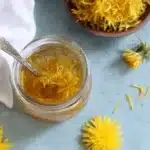

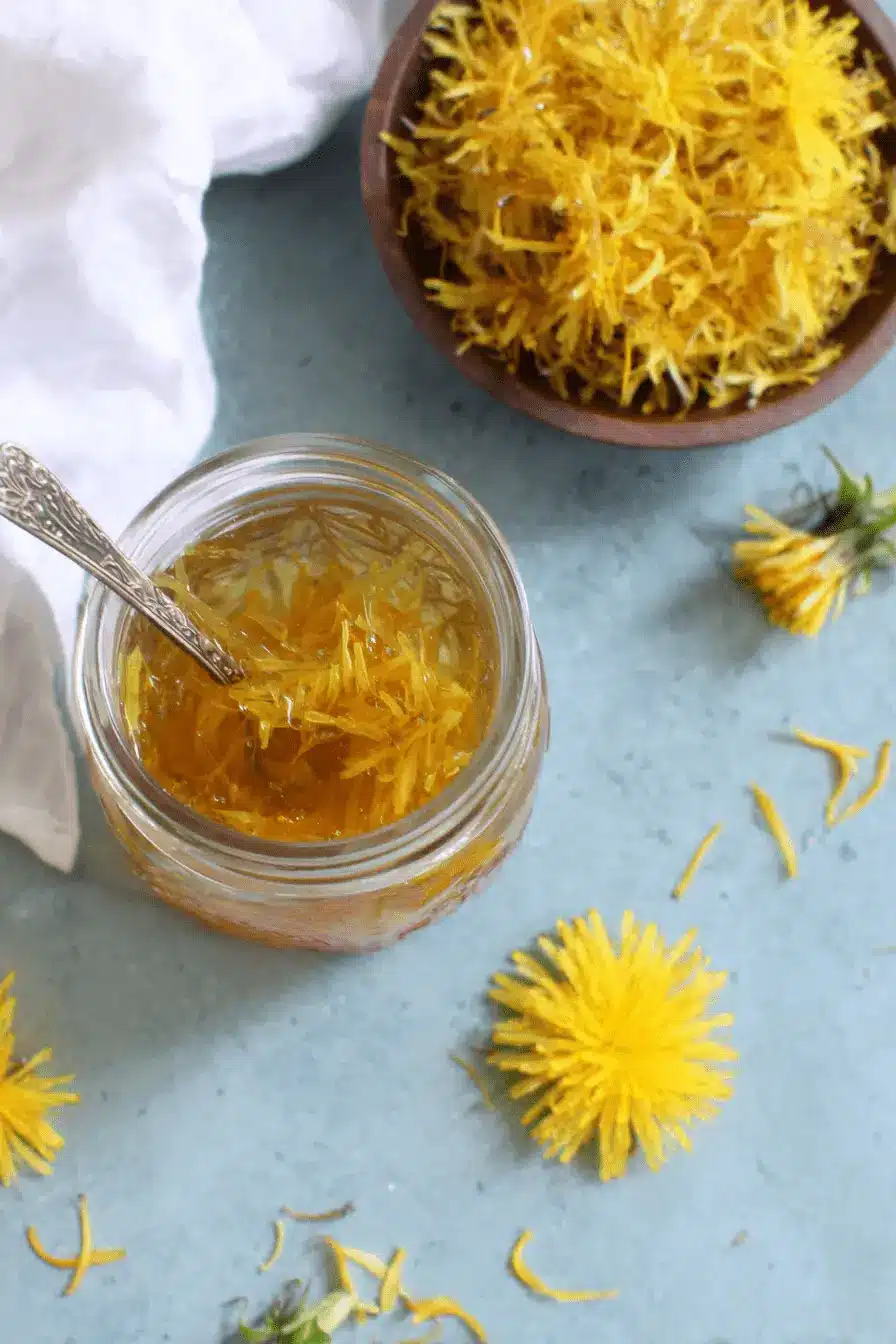
There is something truly magical about turning a “weed” from the backyard into a glowing jar of golden preserves. I used to look at dandelions and just see a chore—something to be pulled up on a busy weekend. But when I started slowing down and looking for comfort in my kitchen, I realized these little yellow flowers are actually full of sunshine.
This dandelion jelly recipe is one of those projects that connects you right back to nature. It tastes remarkably like honey, with a bright, floral sweetness that feels like a warm hug on a piece of toast. While it does take a little patience—steeping the tea can take up to 24 hours, and setting takes another 12 to 48 hours—the active cooking time is surprisingly short.
If you are like me, balancing work and family, you might think you don’t have time for foraging. But trust me, gathering these blooms is a wonderful excuse to step outside, breathe, and make something beautiful from scratch. Let’s capture some sunshine in a jar.
Why You’ll Love This Dandelion Jelly Recipe
I know life is hectic, and making jelly from flowers might sound like a project for someone with way more free time. But here is why this recipe has become a staple in my kitchen:
- It Tastes Like sunshine: If you have never tried it, the flavor is incredible—it tastes almost exactly like a rich, floral honey with a lemony tang.
- Budget-Friendly Comfort: You are literally making food for free! It’s an amazing feeling to turn something that grows wild into a gourmet treat without spending a dime on the main ingredient.
- Beginner-Friendly Science: Even if you have never canned before, this recipe uses powdered pectin, which makes the chemistry part much less intimidating than old-school jams.
- A Gift from the Heart: These jars glow like gold. Handing one to a friend feels so much more special than buying a generic candle.
Ethical Foraging: How to Find & Harvest Dandelions for Your Recipe
Before we start cooking, we need to gather our blooms. Since we are eating these, where you pick them matters just as much as how you pick them.
First and foremost, stay away from areas sprayed with pesticides or herbicides. I strictly avoid roadsides because of exhaust fumes and runoff. The best place is often your own backyard (if you don’t treat your lawn) or a friend’s wild patch.
When you harvest, aim for midday when the sun is high. This is when the flowers are fully open and fragrant. Also, try to leave some behind for the bees! I usually only pick about a third of what I see in a patch so the pollinators stay happy.
Identifying Dandelions: Don’t Confuse Your Blooms!
It might seem silly, but there are look-alikes out there! True dandelions have a specific look that separates them from plants like catsear or hawkweed.
- Single Flower: Look for one single flower head on a hollow, leafless stem. If the stem branches off or has multiple flowers, it’s not a dandelion.
- The Leaves: Dandelion leaves are jagged (like lion’s teeth) and grow in a rosette at the base of the plant, close to the ground.
- The Stem: When you break the stem, it should ooze a milky white sap.
Where and When to Harvest
I love foraging for this dandelion jelly recipe in the spring when the blooms are fresh and tender, though you can find them throughout the summer.
Look for areas away from dog walking paths and high-traffic zones. I find that the early spring flowers have a milder, sweeter flavor, while late-summer blooms can be a tiny bit more bitter, which actually adds a nice complexity to the jelly.
Essential Tools for Making Dandelion Jelly
You don’t need a professional kitchen to make this work. Here is what I pull out of my cupboards:
- Heavy-Bottomed Saucepan: This is crucial. A thin pot can scorch the sugar, ruining that beautiful golden color.
- Fine Mesh Sieve or Cheesecloth: You will need this to strain the petals out of your tea.
- Canning Jars and Lids: Half-pint jars work best for jelly.
- Water Bath Canner (Optional): If you plan to make this shelf-stable, you’ll need a large pot with a rack. If you are just storing it in the fridge, skip this!
- Ladles and Funnels: These make the sticky job of filling jars much less messy.
Ingredients
Here is exactly what you need. I keep it simple so the flower flavor really shines.
- 4 cups dandelion petals (or 2 cups packed petals)
- 4 cups sugar
- 2 Tbsp. lemon juice (or 1/2 tsp citric acid)
- 1 box Powdered Pectin (1.75 ounces, such as Sure Jel)
- Boiling Water
Step-by-Step Instructions for Your Dandelion Jelly Recipe
- Harvest roughly 8 cups of dandelion flower heads. Carefully remove just the yellow petals, discarding the green portions. You should have roughly 4 cups petals (not packed) or 2 cups petals (packed).
- My Kitchen Note: This is the most time-consuming part, but it is the secret to good flavor. The green parts (the sepals) are bitter. I like to grab the yellow petals and pinch/roll them off the green base. Put on a podcast or some music and enjoy the process!
- Make a dandelion petal tea by pouring 4 cups boiling water over the cleaned flower petals. Allow the tea to steep for at least an hour, but as long as 24 hours.
- After steeping, strain the petals, ringing them out to get every last bit of liquid. Measure the liquid, you should have 3 3/4 to 4 cups of dandelion tea.
- Pour the dandelion tea into a heavy-bottomed saucepan. Add lemon juice and pectin, and bring the mixture to a boil over high heat. (Note: Do not add sugar yet.)
- Once the mixture is rapidly boiling, add the sugar and stir to combine.
- Allow the mixture to return to a hard boil, and boil 1-2 minutes before removing from heat.
- Pour the jelly into prepared jars, seal and allow the jelly to cool and set for at least 12 hours. (Sometimes jelly takes as long as 48 hours to fully set, be patient.) Store in the refrigerator.
Making the Perfect Dandelion Tea
The “tea” is the foundation of your jelly, so don’t rush this part. I usually let my petals steep for a full 24 hours. This extracts the deep yellow color and ensures the floral flavor is strong enough to stand up to the sugar.
When it is time to strain, I use a cheesecloth. While you want to wring it out to get the flavor, try not to squeeze perfectly aggressively if you want crystal-clear jelly. Squishing the petals too much can sometimes force tiny particles through, making the final result a little cloudy. It still tastes amazing, though!
Dandelion Jelly Troubleshooting: Why Didn’t My Jelly Set?
I have had my fair share of canning fails, so don’t panic if things don’t go perfectly the first time. Here is what usually goes wrong with this dandelion jelly recipe and how I fix it.
Common Issues and Solutions
- Jelly is Runny (Syrup): This is the most common issue. It often means the acid balance was off or it didn’t boil hard enough. If it hasn’t set after 48 hours, call it “dandelion syrup” and use it on pancakes. It’s delicious!
- Jelly is Too Stiff: This usually happens if you boil it too long after adding the sugar. Watch the clock—1 to 2 minutes is all you need.
- Floating Crystals: This means the sugar didn’t fully dissolve. Next time, make sure to stir vigorously after adding the sugar until the liquid looks clear.
- Cloudy Jelly: As mentioned above, this comes from squeezing the petals too hard or not straining specifically enough. It is purely cosmetic; the flavor is still safe and tasty.
Pectin Power: Choosing the Right Pectin for Your Dandelion Jelly
Pectin can be confusing. It is the natural thickener that makes jelly “gel.” In this recipe, the interaction between the pectin, the high sugar content, and the lemon juice creates the set.
- Standard Powdered Pectin (Sure-Jel): This is what the recipe calls for. It relies on a high ratio of sugar to acidic fruit juice to set.
- Liquid Pectin: Do not substitute this 1:1. Liquid pectin is added after the sugar boils, whereas powder is added before. Stick to the powder for this specific recipe to avoid failure.
- Low-Sugar Pectin (like Pomona’s): If you want to use less sugar, you must use a pectin designed for low sugar. Standard pectin will not set without the 4 cups of sugar listed here.
Pectin Comparison Chart
| Pectin Type | Sugar Requirement | When to Add | Consistency |
|---|---|---|---|
| Standard Powdered (Sure-Jel) | High (Exact Ratio) | Before Sugar | Firm, classic jelly set. |
| Liquid Pectin | High | After Sugar | Slightly softer set. |
| Low-Sugar (Pomona’s) | Low or None | Mixed with sweetener | Customizable firmness. |
Ingredient Substitutions & Variations for Your Dandelion Jelly
Cooking shouldn’t be rigid. Here are some swaps you can make if you are in a pinch.
| Ingredient | Common Substitution | Notes |
|---|---|---|
| Lemon Juice | Citric Acid, Vinegar | Citric acid (1/2 tsp) is great and neutral. Vinegar works for safety but will change the flavor profile significantly. |
| Sugar | Low-Sugar Sweeteners | Careful! Only use these if you switch to a low-sugar specific pectin brand. |
| Pectin Brand | Other Powdered Pectin | Ensure equivalent quantities (1 box is approx 1.75 oz or 6 tbsp bulk). |
Flavor Boosters & Creative Variations
- Vanilla: Add a split vanilla bean to the boiling phase for a “creamsicle” vibe.
- Orange Zest: Swap one tablespoon of lemon juice for orange juice and add a strip of zest during steeping for a citrus punch.
- Ginger: A slice of fresh ginger in the steeping tea adds a warming spice that pairs perfectly with the floral notes.
Water Bath Canning Your Dandelion Jelly (For Shelf-Stable Storage)
The instructions above are for refrigerator jelly. However, if you want to store these in your pantry for winter, you need to water bath can them. It sounds technical, but it is just boiling jars!
- Sterilize: Wash your jars and keep them hot in boiling water.
- Fill: Pour the hot jelly into the hot jars, leaving 1/4 inch of space at the top (headspace).
- Process: Wipe the rims clean, apply lids and bands (fingertip tight), and submerge in boiling water. The water must cover the jars by an inch.
- Time: Process for 10 minutes (at sea level). Turn off heat, let sit for 5 minutes, then remove.
Altitude Adjustments for Safe Canning
If you live deeply in the mountains like some of my family, water boils at a lower temperature. You need to add time to ensure the jelly is safe.
- 1,001 – 3,000 ft: Add 5 minutes.
- 3,001 – 6,000 ft: Add 10 minutes.
- Above 6,000 ft: Add 15 minutes.
Storing Your Homemade Dandelion Jelly
Proper storage ensures all your hard work doesn’t go to waste.
- Refrigerator Jelly: If you skipped the water bath, keep your jars in the fridge. They will stay fresh for about 3 to 4 weeks (if they last that long without being eaten!).
- Canned Jelly: If you processed them in a water bath, store them in a cool, dark pantry. They are best consumed within 1 year for quality, but they remain safe as long as the seal holds.
Beyond Toast: Creative Ways to Enjoy Dandelion Jelly
Sure, this is amazing on buttered sourdough, but don’t stop there. I use my dandelion jelly recipe in savory dishes too!
- Charcuterie Board: Pair it with a sharp cheddar or creamy goat cheese. The sweetness cuts the saltiness perfectly.
- Glaze for Pork or Chicken: Melt a few tablespoons and brush it over roasting meat for a sticky, floral glaze.
- Tea Sweetener: Stir a spoonful into hot black tea.
- Yogurt Topping: Swirl it into plain Greek yogurt with some granola for breakfast.
Frequently Asked Questions (FAQ) About Dandelion Jelly
What does dandelion jelly taste like?
It tastes strikingly similar to honey but with more herbal, floral notes and a bright kick from the lemon. It defines “sunny” flavor.
Can I use less sugar in my dandelion jelly recipe?
Not with standard Sure-Jel pectin. The chemistry requires that high sugar bonding to set. If you want lower sugar, you must buy a box of “Low Sugar” pectin and follow the instructions on that specific box.
How long do dandelions last after picking before processing?
They wilt fast! I try to process the petals (remove the greens and pour boiling water) within 3-4 hours of picking.
What if my dandelions aren’t very fragrant?
Sometimes after rain, the scent is weak. The jelly will still be sweet and pretty, but lighter in floral flavor. You can add a drop of vanilla extract to boost it.
Can I use dried dandelions in this recipe?
Yes! You can buy dried dandelion petals. Use roughly half the amount (2 cups dried) since the flavor is concentrated.
What if the jelly becomes cloudy?
This is usually because the petals were squeezed too hard during straining. It is totally safe to eat; it just isn’t glass-clear.
How do I sterilize jars without a canner if I only want refrigerator jelly?
Simply wash them in hot, soapy water and rinse well. Since you are keeping it in the fridge, surgical sterility isn’t as critical as it is for shelf storage.
Conclusion
I hope this guide gives you the confidence to grab a bowl, head out to the yard, and start picking. There is a deep sense of satisfaction in making this dandelion jelly recipe—turning something wild and overlooked into a beautiful, sweet treat for your family.
Remember, cooking doesn’t have to be perfect to be wonderful. If your jelly turns out like syrup, it’s delicious syrup! If it’s cloudy, it’s still tasty. The joy is in the process.
I would love to hear how your batch turns out! Did you have any “kitchen fails” or big wins? Leave a comment below and let me know. And if you snap a photo of your glowing jars, tag me on social media—I’d love to see your sunshine in a jar!
Dandelion Jelly Recipe
Ingredients
Equipment
Method
- Harvest about 8 cups of dandelion flower heads, then carefully remove and keep only the yellow petals, discarding all green parts to yield about 4 cups loose or 2 cups packed petals.
- Prepare dandelion petal tea by pouring 4 cups of boiling water over the cleaned petals; let it steep for a minimum of one hour, or up to 24 hours.
- After steeping, strain the petals thoroughly, pressing to extract all liquid, and you should have 3 3/4 to 4 cups of dandelion tea.
- Pour the measured dandelion tea into a heavy-bottomed saucepan, add lemon juice and pectin, then bring the mixture to a rolling boil over high heat.
- Once rapidly boiling, stir in the sugar until fully combined.
- Allow the mixture to return to a hard boil and continue boiling for 1-2 minutes before removing it from the heat.
- Pour the hot jelly into prepared jars, seal them, and allow the jelly to cool and set for at least 12 hours, storing it in the refrigerator after it sets.